


2026:2
Taos, New Mexico, is one of those places that makes you remember why small businesses matter. Adobe storefronts. Family-run restaurants. Generations of the same name above the same door. So when I sat down at one of those beloved restaurants recently — a warm, unassuming place where “Christmas” refers to having red and green chili on your burrito — I noticed something new at the bottom of the menu and my bill: a 3% credit card surcharge.
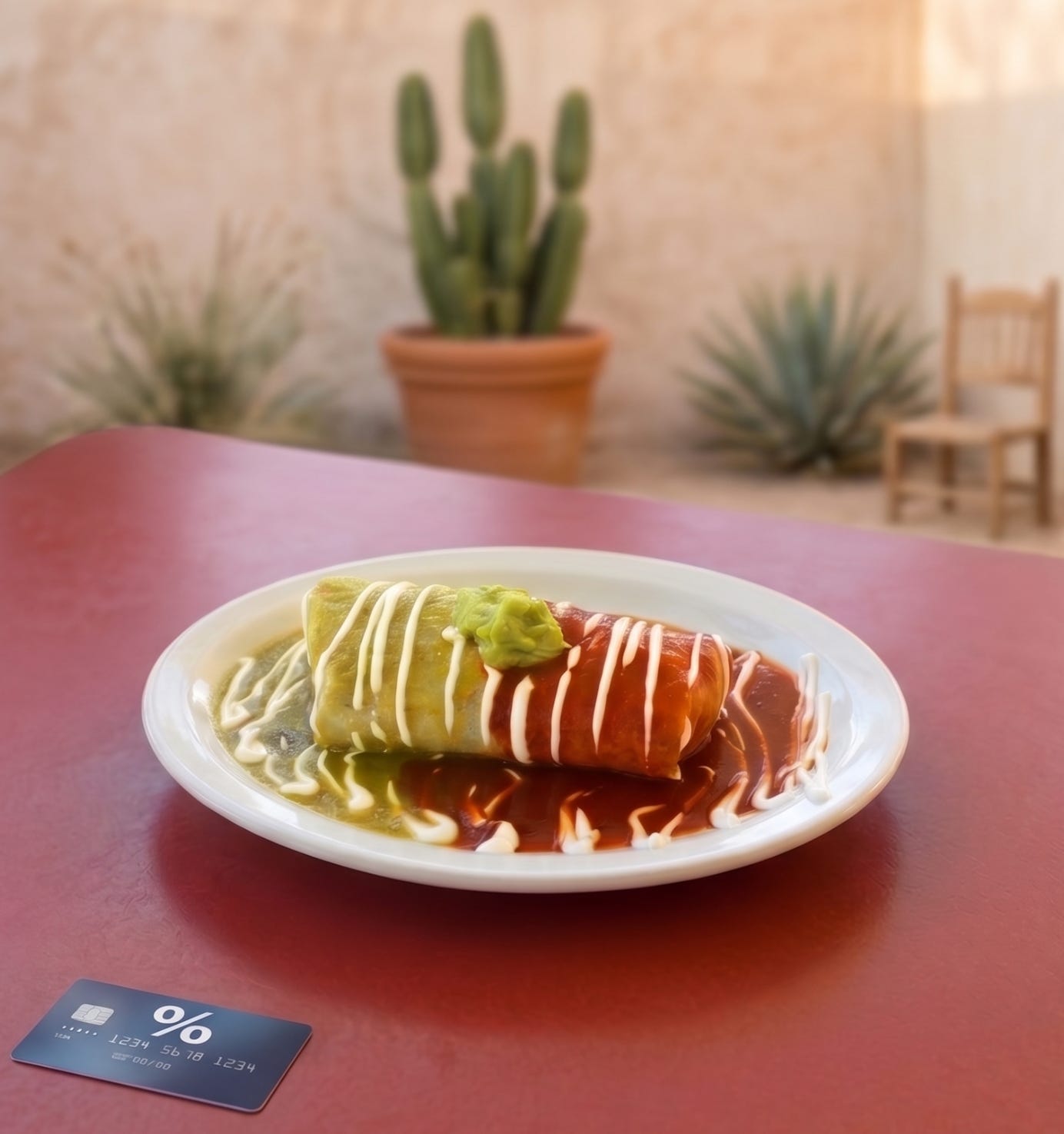
After poking around the next day with a few locals, I learned something interesting that I should have already known if I had been following recent developments. They told me that the small businesses had been required to “eat” or absorb the fee for years. Only recently were they “allowed” to pass the fee along as a separate charge.
That word — allowed — was curious. Since when does a small business owner in America need permission to know what something costs, and to charge accordingly?
Ending a multi-year permission slip
The answer traces back to a federal antitrust case filed in 2005. For two decades, Visa and Mastercard — and the banks that issue cards bearing their logos — were sued by merchants who argued the card networks had essentially conspired to fix interchange fees while prohibiting merchants from passing those costs to consumers or steering them toward cheaper payment options.
The marathon class action began in 2005 when merchants sued Visa and Mastercard over alleged antitrust violations around the interchange rates that retailers, restaurateurs, and other merchants pay when they accept credit card payments. The case ground through the courts for nearly twenty years before producing a settlement that finally, among other things, gave merchants the right to surcharge.
Interchange fees are the amounts businesses pay each time a customer uses a credit card, typically ranging between 2% and 4% of the transaction amount — fees set by the payment networks and collected by issuing banks. Unlike debit card transactions, which are governed in part by the Durbin Amendment, credit card interchange fees are not capped under federal law. The result was two decades of unchecked fee growth while merchants were contractually silenced — forbidden even from telling customers what it actually cost to swipe that card. For the first time, the settlement of the anti-trust lawsuit allowed changes, including passing the fee along directly to customers.
What the Taos restaurateur was doing — that 3% surcharge — wasn’t an easy business decision so much as the long-delayed exhale after the chokehold finally loosened.
Call it what it is: A tax on small business
Here is the uncomfortable truth that the antitrust complexity obscures: interchange fees function, in practice, as a private tax on commerce — one levied not by any government accountable to voters, but by a duopoly accountable only to shareholders.
Industry data indicates that Visa and Mastercard collected more than $111 billion in credit card interchange fees in 2024. Every dollar of that came from somewhere — primarily from the margins of businesses too small to negotiate their own rates. The corner bakery, that family diner in Taos, the independent bookstore. They all pay the same posted rate, while Amazon and Walmart sit across the table and cut deals.
And unlike a government tax, this one carries no democratic accountability, no revenue to fund roads or schools, and no public debate about the rate. It is a toll booth erected in the middle of every transaction in America, and the toll goes straight to banks and card networks.
Going back to cash isn’t the answer
An obvious rejoinder to all of this is: just go cash-only. A few restaurants in Taos have tried it. And while the romance of a cash economy has a certain appeal — no fees, no middlemen, no surcharges on the menu — the operational reality is challenging in ways that aren’t discussed enough.
Cash has to be kept somewhere. For a busy restaurant doing a Saturday dinner service, that means a safe, a system for counting, and real anxiety about what happens if someone figures out where the deposit is kept overnight. Robbery risk is not hypothetical for small merchants; it is a line item in the mental budget of every owner who has ever walked out the door with a bank bag under their arm.
Then there is employee theft, which is one of the most quietly pernicious problems in food service and retail. Cash creates bad opportunities in ways that card transactions don’t. A digital transaction leaves a record. A twenty pulled from a drawer does not. The American Restaurant Association has long flagged internal theft as one of the leading causes of small business failure in the industry, and cash-heavy environments are the most vulnerable. Surcharges and interchange fees are a burden — but so is building a culture of suspicion among your own staff.
And then there is the sheer logistics of banking cash. Someone has to count the drawer every night. Someone has to make the deposit — ideally not alone, ideally not at the same time every day. For a small operation with thin staffing, that is not a trivial ask. Every trip to the bank is time not spent on the floor, in the kitchen, or managing the hundred other fires that define small business ownership.
Cash, in short, trades one set of costs for another. The Taos restaurant owner isn’t wrong to want a better option. The surcharge is a symptom. What the economy actually needs is a third way — one that doesn’t extract like the card networks and doesn’t carry the operational weight of cash.
Europe built an off-ramp. Why can’t we?
Here is where the story gets genuinely interesting — and frustrating.
Wero is a European mobile payment system launched in July 2024 by the European Payments Initiative, built to compete with PayPal, credit cards, and similar services. It is an account-to-account payment network — meaning money moves directly between bank accounts, with no card network intermediary skimming 2-3% from every transaction. Wero eliminates card network intermediaries and lowers transaction costs, backed by a consortium of major European banks. Wero already has over 47 million registered users in Belgium, France, and Germany, has processed over €7.5 billion in transfers, and counts more than 1,100 member institutions.
The model is essentially a producer cooperative: European banks pooled resources, built shared infrastructure, and created an alternative that benefits merchants and consumers rather than extracting from them.
Which raises the obvious question: why hasn’t the American credit union movement done exactly this?
Credit unions already operate on a cooperative model. Credit Union Service Organizations — CUSOs — exist precisely as the vehicle for credit unions to pool resources and build shared technology and financial services. This concept of shared infrastructure is not foreign or exotic. The mission alignment is perfect: member-owned institutions building payment pathways that serve members and the small businesses that anchor their communities.
A CUSO-anchored payment network — call it a AmWero — built on the FedNow instant payment rails that the Federal Reserve launched in 2023, could theoretically offer merchants account-to-account payments at a fraction of interchange costs, embedded directly in the mobile apps of the nation’s 135 million credit union members. We are seeing a few “green shoots” of a movement with BankSocial and Payfinia.
But, what is still missing is a piece of bringing merchant locations into the family. So, why not? The honest answers are uncomfortable: fragmentation among credit unions, the complexity of achieving the critical mass needed for merchant adoption, the political and financial influence of the very card networks credit unions rely on to issue their own Visa and Mastercard-branded products, and perhaps a failure of collective imagination among movement leaders.
The question we need to ask
The restaurateur in Taos is now passing along a fee that was always there — just hidden. That’s a small and incomplete victory. The real question is whether Americans will continue to accept a privatized tax on every transaction, or whether the cooperative financial sector will finally ask: if European institutions can build Wero, what exactly is stopping us?
The enchiladas and burritos in Taos are still worth it. The surcharge shouldn’t have to be.
About the EduPartners.news and the Ex4EDU.Report.
This publication is offered as a free-of-charge contribution by EduPartners.coop, an educational services limited cooperative association focused on transformation in higher education, in partnership with Lone Tree Academics LLC. Our services are focused on solutions for the development of institutional and program strategies, crafting engaging LearningScapes™, and developing programs of the scholarship of teaching and learning.
For more information visit www.edupartners.coop.
Lone Tree Academics LLC also provides a newsletter, Ex4EDU.report, which focuses on bigger pictures issues in higher education from the perspective of transformational quality.